CGR Critical Raw Materials
The Circularity Gap Report: Critical Raw Materials
Key messages
Why a Circularity Gap Report on Critical Raw Materials?
Securing critical raw materials has become one of the defining questions of the decade. Demand for the materials underpinning clean energy, digital infrastructure and advanced manufacturing is rising faster than supply systems were built to deliver, while extraction and processing remain concentrated in a small number of countries. Governments and companies are already responding with new mines, trade agreements, strategic reserves and industrial policy.
This report examines how the circular economy can reshape the dynamics of critical raw materials by reducing how much material is needed in the first place, extending how long it stays in use, and increasing how much returns to the economy when products reach end of life. This practical dimension of circularity has received less attention than circular economy initiatives in other sectors, yet the evidence presented here suggests it does much of the work.
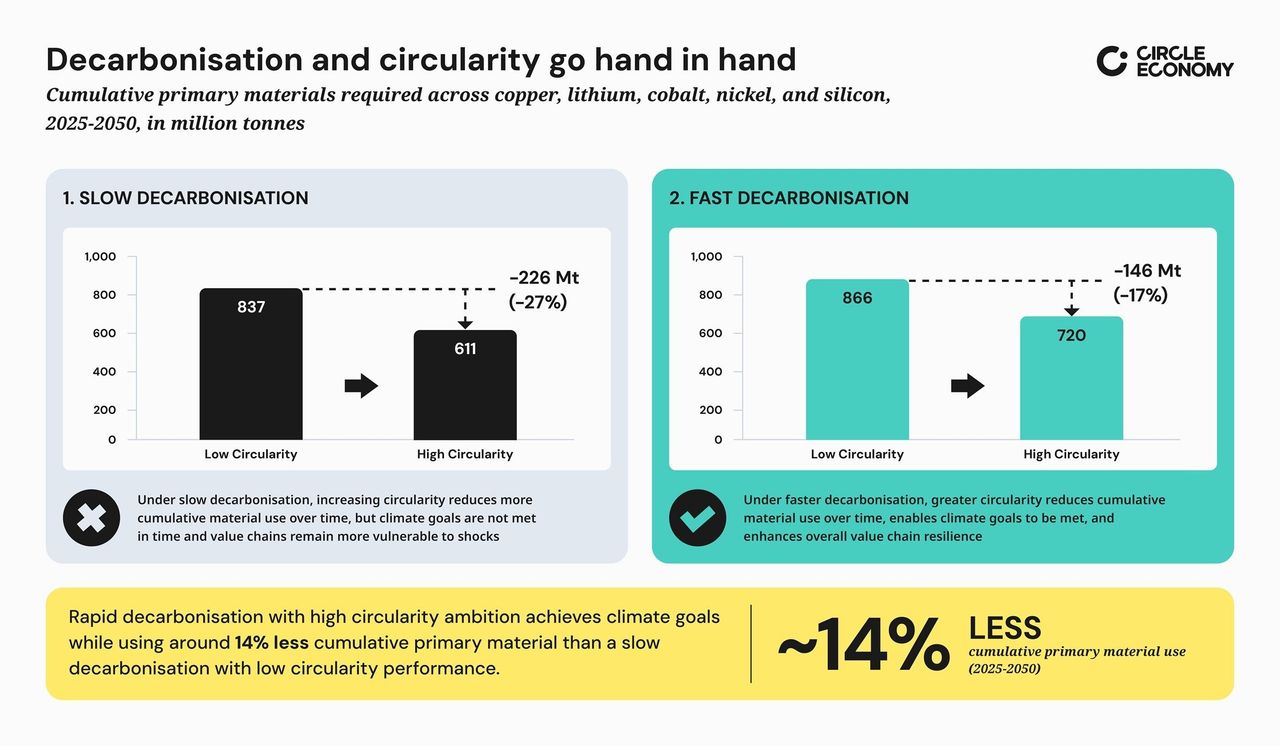
In a context of intensifying demands over resource access, circularity is a strategic and economic necessity that also delivers environmental benefits. Reducing dependence on primary supply can strengthen supply security while lowering the environmental and social costs of extraction. These objectives are not competing. In fact, a faster energy transition combined with high circular ambition could require around 14% less primary material than a slower transition with today’s circular performance, while creating a system that is better able to withstand disruption.
What was analysed?
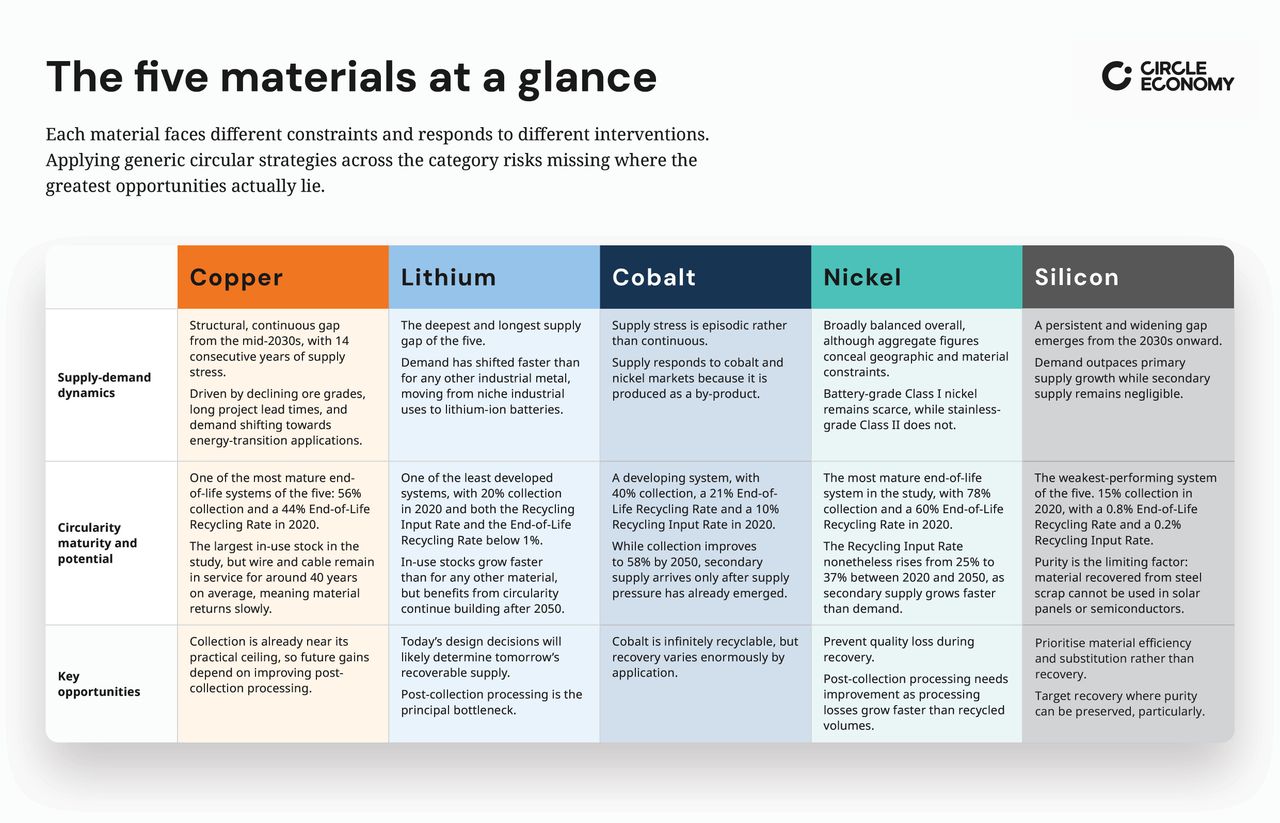
The analysis tracks five critical raw materials—copper, nickel, cobalt, lithium and silicon—through the global economy from 2020 to 2050 using dynamic material flow analysis coupled with system dynamics modelling. It follows each material from ore through refining, manufacturing and use to end-of-life, capturing how much accumulates in products and infrastructure and when it becomes available for recovery. Outcomes are tested across three decarbonisation pathways and three levels of circular ambition, and then subjected to supply disruptions. The scope is global: it does not distinguish between countries or trade flows. All quantities are reported as refined materials, unless otherwise stated.
The Circularity Gap Report is an initiative of Circle Economy, an impact organisation dedicated to accelerating the transition to the circular economy.
© 2008 - Present | RSIN 850278983